Monday, May 21, 2007

Alas, Cutty Sark


We hardly knew ye. The famous clipper ship was undergoing extensive restoration when she was severely damaged by a suspicious fire today. Luckily, up to 50% of the ship is in storage, and so it may be salvageable. Today Hokum gives the old girl a heartfelt salute from the champagne-bottle's view. Make that the scotch whiskey bottle's view. What lines she had, and how she did ramble...

Thursday, May 17, 2007

Dangerous Gals, Coddled Kids: More Thoughts on The Dangerous Book for Boys

You would think that gender is a touchy subject in a household with an academically-trained feminist and a fairly unreconstructed 45-year-old boy. Well, not so much. Dee and I watch James Bond movies together. We may not be watching exactly the same movie (She: "Ugh. Okay, I get it. Smack, smack, smack. I hate these fight scenes— they just go on and on" ) but we both live for the gadgets and the stylish locales (I just double-checked, and she confirmed). The fact is, we are pretty evenly matched on the gender-assigned indulgences: I still troll eBay and Amazon for deals on pulp fiction, and she has a fetish for pink accessories. Our excuse is that we are post-modern, ironic urbanites but the reality is that we are relatively well-adjusted adults, each with a good a sense of humor and a dash of sentimentality.

I'd say most folks who contributed to Mother Talk's current Blog Book Tour are in that same category, judging from the overwhelmingly positive responses to The Dangerous Book for Boys. (See my own review posted below). Mothers seem to appreciate the constructive energy outlet the book offers for their sons and husbands, and they are enthralled by the book themselves. Kris at WonderMom wants to try her hand at being a WhizMom—— she's got a couple of years' head start on her five- and six-year-olds to learn some gadgetry from the book. Dani at Postcards from the Mothership ended up channeling her "inner-12-year-old boy," and Bethany at Mommy Writer Blog declares it to be the "KID BIBLE." Tellingly, it reminds her of the very things her father taught her when she was a little girl.

Here, I think is the crux of the matter: Dangerous is only a book for boys if by "boy" you mean any kid with heart and moxie. Fathers of past generations were conditioned to pass their moxie on to their sons, not to their daughters; they were content to let their daughters remain precious and mysterious, beyond their understanding and direct influence, except when there were no sons. Bethany and her sister, sure enough, had the Moxie bestowed upon them by their dad in the absence of brothers, which meant learning tree lore, and how to fish Brook Trout, Salmon, Pike, and Walleye, among other things.

In a similar vein, my own Dee, aka Deborah Siegel, recounts her experience as an only child in her essay “Triangulation: a Love Story” (from her anthology Only Child): how her father took her into the yard to watch electrical storms thundering in off Lake Michigan, and took her skiing down blizzard-swept slopes while they screamed at the top of their lungs. Believe you me, Dee still has Moxie to spare, which suits her bookish boyfriend just fine. She's become something more than a muse to me: she's also sideline coach and cheerleader, coaxing me onto ski lifts and saddles, prodding me to buy myself my first bicycle in a half a lifetime. When the time comes, I'll have no reason to leave any daughter of mine out of the boy's club. Hell, Dee will probably be the activities director!

Speaking of activities, I think one of the great boons of The Dangerous Book for Boys is that, by its very existence, it champions the right for kids to muse and ponder. Sure, set aside that Saturday afternoon to build a treehouse together... but for Pete's sake, let the kids alone to sit up there and veg (vedge?) out for a little while. To quote George Carlin, "Leave your kids the F__k alone! There's way too much structure!" Of course, he jokes about dumb kids doomed by Darwinian Natural Selection in the same skit, but he's only following Jonathan Swift's model: drop a pearl of wisdom into a keg of outrage. I'm sure my views will morph a bit once I have a child, but I do remember enough of my own childhood to know how much I valued the endless, featureless days of summer. Plenty of time to get in trouble, yes—— it was in the age before "playdates," and before the city put rubber mats in all the playgrounds. I once climbed the monkey bars unsupervised and dropped headfirst onto the bare asphalt. But reflexes honed by years of fending off neighborhood bullies (i.e., covering my head with my arms) served to save me from serious injury. I'm not sure you can pick up those reflexes from a Playstation or an Xbox. It's possible, I suppose.

"Dangerous" is a loaded term. So is "boy," and so is "girl," especially in relation to "dangerous." Parents are intrigued and disturbed by the emotions and associations around these terms that have been dredged to the surface by the popularity of this book. Here are a few final meandering thoughts on this: I don't think it is a coincidence that darkness has regained currency in children's literature and fantasy films lately. From Harry Potter and the Deathly Hallows to Revenge of the Sith to Bridge to Terabithia, danger is a palpable element. In the real world, crime levels may be down in the cities, but there's a war on—— kids nowadays can't be fooled. They know the world is a dangerous place. I don't believe it serves them well to be continually coddled and sheltered and hermetically sealed off from the world with helmets and shin guards. They need to know they can wield a sword or a light sabre to defend themselves against the Dark Side, or learn how to overcome obstacles, to swing over a chasm or a creek on a well-knotted rope, or simply to learn the magic needed to find one's way back home through a dark wood.

They need to find their own heart (and brain, and courage). Dorothy did, and she managed to find her way back to Kansas. Leslie Burke never came back from Terabithia, it's true, but she passed her heart, her Moxie, on to her best friend. And yes, Dorothy and Leslie were both girls. Amelia Earhart, Bessie Coleman, Beryl Markham, fearless adventurers all. So why The Dangerous Book for Boys? Because boys (and fathers) need to make believe, at least for a little while, that their secret is safe. Yet most kids know in their hearts the truth about Santa Claus long before the lie dies out in their minds. Boys will figure out the truth eventually.

Sea Leaves: The Cyanotypes of Anna Atkins


As I was researching the previous post and trolling the Internet for Victorian women explorers and/or naturalists, I recalled the Lady of the Algaes:

Anna Atkins (1799-1871) was a pioneer in the use of photography to document nature. In 1843 she published the scientific catalog Photographs of British Algae: Cyanotype Impressions, said to be the very first book of photographs. Her work manages to be intensely personal and stunningly beautiful, specimens of a time when science could seem as lyrical as poetry, although in Atkins' case some of this lyricism is arguably an accident of technique. The blue tint of her cyanotype impressions is a result of the chemical process she used, which was originated by Sir John Herschel, a friend of her father's. While she applied the technique as a more objective alternative to drawing from life, the results go beyond objective accuracy into the sublime. The dead specimens of algae, ghosts of light and nature, float against a virtual blue abyss in an ironic inversion of the romantic trope of pressing flowers in books to preserve them. In 2004 her work was featured in the exhibit Ocean Flowers: Impressions from Nature at the Drawing Center in New York City. The Center published a beautiful companion catalog by Catherine de Zegher, Carol Armstrong, Edward Eigen, Craigie Horsfield, Elaine Scarry, and Kathryn A. Tuma, which is, alas, currently out of print.

The reproductions above are from the first volume of Photographs of British Algae, and can be found on the New York Public Library Digital Gallery website.

The Once and Future Boy


The Dangerous Book for Boys, Conn Iggulden, Hal Iggulden.
Sometimes, despite my best efforts to the contrary, I find myself out of the loop on subjects of great importance. I surf and I browse; I peruse news sites and blogs and magazine stands and mega-bookstores, yet somehow or other I missed the last big peace demonstration, and worse, I missed the early word on the Iggulden brothers' wonderful Dangerous Book for Boys.

My partner Debbie Siegel (aka Girl w/Pen) has watched me struggle with the intent of this blog of mine over the past year or so, and has endured my droning on and on about the lost mysteries of boyhood and how kids these days are just so jaded; so when Mother Talk dedicated their second Blog Tour to said Dangerous Book she knew who to forward the email to. Of course, when I saw the cover design I knew I had to order it; when I unwrapped it I experienced a kind of Christmas morning giddiness.

Dangerous is a glaring anachronism: with its red clothbound covers and retro design circa 1910, it resembles some forgotten and miraculously preserved first edition of Frank L. Baum. No glossy dustjacket, no blurbs, no Oprah sticker (please, God, spare it the Oprah sticker), it exists outside of the moment, outside of media. Inside, there's no rhyme or reason—— just pure careening no-nonsense wonder and how-to. It reminds me a little of another recent anachronistic publishing phenomenon, Schott's various Miscellanies (and Almanacs and Concordances and whatever else in God's name Ben Schott's got coming down the pike). Like Schott's books it takes the randomness of web-surfing and formalizes it as a literary experience outside of the headlong rush of information familiar to Generation Y. It's apparent that The Dangerous Book for Boys has no beginning, middle or end. It is meant to be read and perused, like the World Book or the Encyclopedia Britannica, rather than scanned, tabbed and bookmarked.

Its contents have a distinctly Anglophile charm: segueing from stickball and rugby rules to Morse code and cloud formations, Dangerous seems intended for some unlikely jock-geek hybrid, equal parts introvert and extrovert. In fact, what with chapters on polar exploration, navigation, historic battles and the Seven Wonders of the Ancient World, some might argue that the Igguldens have compiled a kind of throwback primer for young male WASP imperialist-adventurers educated in the classics; indeed a great part of the book's appeal is its obstinately old-world presentation (the Seven Wonders are illustrated by what look like reproductions of Victorian postcards). The Age of Imperialism did coincide with the broader cultural impact of the Industrial Revolution, and so technology enabled not only global travel for the original tourist class, but also the wide dissemination of travel literature to a reading public, including the first generations of young armchair adventurers (boys and girls: remember lonely little Jane Eyre sitting cross-legged "like a Turk" on the window seat, browsing a natural history of the "bleak shores of Lapland, Siberia, Spitzbergen, Nova Zembla, Iceland, Greenland"). Some boys of those generations may have ended up becoming colonial administrators and big-game hunters, but other boys and girls became anthropologists and naturalists for the enlightenment of future generations.

Ultimately, what makes this treasure-trove of a book truly “dangerous” is the idea that a life of sensations and engagement with the world can dovetail with intellectual curiosity, and that any boy (or girl!) with a healthy interest in the world as seen on a map or from high up in a tree house might find a richer sense of place than in any gaming platform, or in a multitude of Facebooks.

Tuesday, May 15, 2007

“Be My Pal” Update


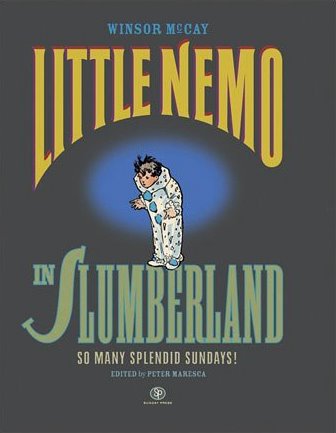
Back in the time before the rains, I posted an admittedly rhetorical plea for charity. I’ve suddenly realized it’s time for an update: I now have my very own copy of
Little Nemo in Slumberland: So Many Splendid Sundays!, purchased for a reasonble price at the Strand. I have no idea if there are any left (this was a few months ago). Why don't you do yourself a favor and pay the old bargain book emporium a visit? And let me know if they've opened the café yet...

Wednesday, May 09, 2007

The Original Graphic Novelist


Ever since I was introduced to peacay's fantabulous BibliOdyssey I've wanted to do my own gallery thing. Well, due to fortuitous circumstances (to wit: a gift from my good friend M. Thibodeau and the source of these wondrous images) today's Hokum is a reasonable approximation.

This is a small selection of woodcuts by Lynd Kendall Ward (26 June 1905 – 28 June 1985) from his "novel in woodcuts" Mad Man's Drum, published in 1930 by Jonathan Cape Harrison Smith. Ward is known primarily for his stark wordless morality tales with hues of social conscience and Methodist justice, early precursors to today's graphic novels. I haven't yet had the chance to thoroughly "read" the book, but near as I can figure it's about a white man, possibly a slave trader, who kills an African man for his drum, and the disasters which befall him and others back home as a consequence.

What really strikes me about Ward's work is how reminiscent they are of the expressionistic cinema of his day: Mad Man's Drum is essentially a silent horror film in the vein of F.W. Murnau and Fritz Lang.

The complete Mad Man's Drum can be found online here, at a lower resolution. Lynd Ward's other woodcut novels are:
God's Man (1929)
Wild Pilgrimage (1932)
Prelude to a Million Years (1933)
Song Without Words (1936)
Vertigo (1937)

Tuesday, May 08, 2007

American Journalism: Off the Monitor, In D.C.’s Face


(Digital Media Fatigue Syndrome: How to Deal, Part 2)

Whether it's intended as a thumb in the President's eye or a bracing slap to the collective face of a dishevelled and discredited Wahington, D.C. press corps
, the new Newseum building currently going up on Pennsylvania Avenue and scheduled to open on October 15th is certainly not just a stodgy mausoleum for journalism past. Its double-edged message is up front and center: a sleek modern facade of glass framed in concrete (evoking an enormous computer monitor), coupled with the fourth estate's historic anchor, the First Amendment, set in a huge slab of stone hovering over the heads of all passersby. Inside will be interactive exhibits galore and a media wall which will be visible from the street. And in a concession to the importance of lifestyle these days, the luxurious Newseum Residences will also be part of the scene. (Check out the views!)

The high-tech sheen is to be expected, as revered news orgs across the country scramble to keep profitable and relevant in the high-volume, byte-sized Internet Age. In a particularly canny move, however, the Newseum will double as a repository of historic artifacts, ranging from the gee-whiz of Edward R. Murrows' microphone (top, left) to the sobering souvenirs of the ongoing calamity, such as bullet-ridden news vans and murdered newsman Daniel Pearl's laptop. As a D.C. experience for young and old, the Newseum will fall somewhere between the exhileration of the Air and Space Museum and the sombre hush of the Holocaust Memorial.

As I opined in a previous post, it's ever more important to look away from the phosphene stream once in a while and replenish our ties with unmediated, concrete reality, whether current or historic; especially as the distinction between conscientiously delivered news and passively consumed and processed information begins to blur. One would hope that to gaze upon Murrow's vintage microphone is to be struck not only by the man's lingering physical presence but by the personal conviction that proved more powerful on the airwaves of his day than the market-tested banalities of dozen HD-enhanced, silver-coiffed anchors in post 9/11 America.

From Menlo Park to Linkin Park


With apologies to and in appreciation of Tommy Alva...

(The "father of Jazz," trumpet king Buddy Bolden of New Orleans, is said to have cut an Edison cylinder. If so, it has never been found, and it is unquestionably the Holy Grail of Jazz.)

Thursday, May 03, 2007

DMFS*: How to Deal, Part 1


The Great Ideas series, Penguin UK

Novelty and backlash, trend and counter-trend. *Digital Media Fatigue Syndrome rears its ugly head yet again. The first time around it was the compact disc versus the vinyl record: crisp flat crystalline sound versus space, warmth and surface noise. Eventually one medium absorbed the other, and now we enjoy reasonably warm digital sound while the ticks and pops of the vinyl era are immortalized in the mash-ups and remixes of countless DJs and turntablists.

These days, as we devote yet more time to tapping away at our metal and plastic keyboards and scanning streaming layers of text and image, we may cynically wonder if our fingers will soon forget the texture of the printed page, let alone the sensation of pressing pencil to paper and actually writing.

It was a case of the shock of the old when I first happened upon a volume from Penguin UK's Great Ideas on a writer friend's coffee table. The book was George Orwell's Why I Write, with a nifty retro cover, an homage to master typographer Jan Tschichold's austere but honest Penguin paperbacks of the postwar era. Better yet was the rich embossing on the cover, hearkening back even further to the days of letterpress and handcrafted bookmaking. It wasn't long before I found a selection of Great Ideas volumes in the stores and I picked up a starter set, which I felt obliged to photograph in the warm light of a reading lamp (above). Each cover design in the series is unique, but they share in common a spare elegance. Slim and pleasant to hold, each book invites a moment of reflection even before opening and reading, a moment snatched out of the headlong rush to scan and absorb we are all too often engaged in– a welcome relief from acute DMFS.

Tuesday, April 10, 2007

Men Will Be Webslingers

So, as I ponder the fate now of both name and image for this blog (see below, and here), it's nice to know that certain things that shouldn't change don't change. My posse of ex-art-school buddies and I were able to carve out a slight niche in our respective family/fiancé/job-centered schedules to meet in the Telephone Bar last night to toss back a few and make serious plans for the future, sleeves rolled, elbows on the table. John, who's getting married in a few weeks, set his pint down sharply and leaned forward, gathering us all in with his no-nonsense glare. "So, listen... Spider-Man 3 is out real soon. We're going, right?" Anthony the architect eased back in his chair and smirked. "Dude, you're gonna be on your honeymoon." John's eyebrows shot upwards in dismay, which sent his glasses down his nose an inch. "Yeah, but can't you guys wait a week?" We all cracked up and reassured him. I was a bit surprised, though. "John, I didn't realized you were so excited by this one. Doesn't your cynicism level normally go up with each sequel?"
"Hey man, the second one was better than the first!"
"Oh— yeah?" Wayne the painter sounded doubtful.
"True," I said, "but this one's with Venom. Isn't he more of a Gen X thing?" I exchanged glances with Wayne, who nodded, frowning thoughtfully. John counted off on his fingers. "Dude: Venom. Sandman. Hobgoblin."
"And Gwen Stacy," Anthony pointed out.
"Holy shit, that's right." I had a sudden vision of myself explaining this to my feminist sweetie. ("Honey, we've got to see this movie. Gwen Stacy's gonna be in it."
"Who's that? Some super evil chick?"
"No. She's Peter Parker's original girlfriend. Before Mary Jane. His true love."
"Wait, I'm confused. This is from a
comic book?"
"Think of it—— as something on Lifetime."
A low blow, trying to appeal to her post-academic indulgences. Wouldn't work.)

Spider-Man is the great equalizer of males, five-year-olds to fifty-year-olds. I realized this back in the heady days leading up to the release of the first movie; there was a sharpness to the air, a charge settling down over NYC like the flush of a coming summer storm— like Spider-Sense. I remember a swank, professional couple in their forties walking past me on the sidewalk. The woman moved briskly, distracted, looking as if she were reeling off a Filofax in her head. Her husband, apparently unencumbered in his business suit and tie, ducked and dodged alongside, jabbering excitedly and firing his web-shooters, fingers twisted into that familiar proto-devil-sign salute. I continued on my way, smiling to myself. I understood. He was resorting to sign language, because she was just not wired to make sense of the words. He was pleading for a change in the schedule, a little niche of time, that's all, to be a webslinger again.

Sunday, April 08, 2007

Sighted!


Well what do you know, the damn thing actually existed!
Above is an 1868 photo of the Albatros Two, the real life counterpart to my blog's brittle mascot flying machine (see masthead, at top). Designed and built by French aviator Jean-Marie Le Bris, it was the second and less sucessful Albatros, although it was the first flying machine ever photographed. Albatros One is on record as having gone airborn in December 1856 to a height of about three hundred feet, for a distance of six hundred feet, making it a contender for first heavier-than-air craft to lift higher than its point of departure (will have to review what the criteria for actual flight is, since Orville and Wilbur Wright still hold the distinction of official First Flyers in December of 1903). Albatros Two didn't fare nearly as well, despite the support of the French Navy in its production and the addition of a few supposed "improvements" in its design.

At first I was delighted, well, jazzed, actually, to discover the Albatros when I was researching the celebrated Parisian photographer Nadar (he took the picture); but I soon realized I preferred the jaunty little flying machine when it was just a bit of whimsy, kith and kin to the likes of Chitty Chitty Bang Bang or the obligingly psychedelic Yellow Submarine. I find instead that the Albatros was patented, tested, sweated over, and most likely cursed and abused in the end. In other words, not exactly "Hokum."

We're all at least a little disappointed when the blurry but uncanny monster photo turns out to be a hoax, or at best a case of wishful thinking. But feelings can be a bit more complicated when the reverse happens and the myth is revealed as fact. Schliemann's Troy and Layard's Nineveh were of course astounding archaelogical discoveries in their time, bringing Homeric antiquity and Biblical scripture to life, respectively; yet I can't help but feel that all the excitement must have been tempered by some small sense of loss, as the collective imagination yielded up its treasures to the cold light of day.

You could say that my old bit of hokum has become, for now, a bit of an Albatros around my neck.

Tuesday, November 14, 2006

Metaphor-Sickness

It's morbidly fascinating for boomers like myself to feel our wires getting fondled and pulled free and reconfigured by a rapidly morphing media environment. Or, to use a new-school metaphor, sometimes I feel like a device who's been set to automatically update with the latest paradigm when I plug into the stream. What's the paradigm of the week? Podcasting and YouTube are installed and running smoothly in my mental hard drive, while Flickr and MySpace are still just, uh, a little too immersion-driven for this passive consumer to run without fear of crashing my system. My point here is that it can be a truly visceral experience: I can practically feel my neurons pushings out shoots and branches to handle the load. But (metaphor number three— or is it four?) it'll be a while before I develop the gills and fins to swim freely in this new ocean with all the newbies.

Speaking of which, Gen X and Gen Y are probably not quite as self-conscious of how they engage media culture, or else don't very much care... Whatever. Gen X took to PCs as naturally as we took to TV, and certainly Gen Y is genetically equipped to morph on command; clunky "re-wiring" is of no concern to them. In fact I'm sure I've got the wrong metaphor here: the appropriate technology hasn't arrived yet. In any case it'll be something more organic. No wires or sparks. Something to do with flux, or clouds, or ecosystems, or glands. You know, like how in Alien the android Ash turns out to be all soft and sloppy inside like a real organism?

Alright, that's it. I wash my hands of the matter. Let the kids figure it out; I just ate breakfast.

Thursday, October 05, 2006

Kicking the Movie Habit

Two of cinema’s die-hard champions of blockbuster entertainment have now gone on record to announce its demise. A while back, sometime between the phenomenal success of The Lord of the Rings and the disappointing returns of King Kong, Peter Jackson claimed to be much more interested in the future of gaming than in the future of movies; indeed, he seems to have begun the transition by taking on the next big game-to-movie project, Halo, as executive producer. And yesterday’s Daily Variety quotes George Lucas at the groundbreaking ceremony for the renamed School of Cinematic Arts at USC:
“We don't want to make movies. We're about to get into television. As far as Lucasfilm is concerned, we've moved away from the feature film thing because it's too expensive and it's too risky. I think the secret to the future is quantity.”
Hold on there, roll back tape. Did the man say this at the groundbreaking of a film school? Well, yes and no. While George is nothing if not perverse, (ask anyone in rank-and-file geekdom), his choice of words bear some examination: he’s not quitting cinema, he’s quitting movies; specifically that, uh, “feature film thing.” The University of Southern California, for that matter, never had a “movie” department; the School of Cinematic Arts was previously known as the USC School of Cinema-Television. The operative concept here is “moving images” on an elemental level; the economic, technical and cultural specifics are transient: mass audiences lining up for tickets and filling theaters are gradually becoming obsolete. Here's Lucas musing on big budgets (something he knows a thing or two about):
“For that same $200 million, I can make 50-60 two-hour movies. That's 120 hours as opposed to two hours. In the future market, that's where it's going to land, because it's going to be all pay-per-view and downloadable.”
And then he gets to the core of his argument, the future of consumer behavior (a subject he's gotten grievously wrong in the past— but he just may be on to something here):
“I don't think anything's going to be a habit anymore. I think people are going to be drawn to a certain medium in their leisure time and they're going to do it because there is a desire to do it at that particular moment in time. Everything is going to be a matter of choice.”
So, Americans are kicking the movie habit, mostly because there are just so many ways out there now to see and to do. Time and again, the first thing that new media rejiggers is language, even as we try to sort out our new behaviors— which I believe will eventually be called “habits.” And so we find ourselves again at a semantics crossroads: perhaps it’s time for ”film,” “cinema” and “movies” to part ways, once and for all.

Tuesday, January 17, 2006

“Buy Me This If You Wanna Be My Pal for Life” Dept.


Just when I think “I’m strapped... can't look at another art book or my wallet will turn into a black hole and suck me bodily into the pits of bibliomania hell along with a few semi-innocent bystanders...” along comes this. A gargantuan hardcover tome of Winsor McKay's classic early 20th C. Sunday comics reproduced in the original tabloid proportions—lavish and precious and unexpected, but likely to be injurious to my tendons nonetheless. Likely to end up as ballast for my swaying IKEA bookcase—you know, just in case my cats decide to grow opposing thumbs and try pulling the damn thing over on its side once and for all. Of course it would be very pretty ballast, compared to that unread slab I've had for years, the one with the hundred and one views of the temple of Karnak.

Wednesday, January 11, 2006

Archaeology in the Age of Transparency, Part I

Pulled from the bookpile:
Blink by Malcolm Gladwell
VALIS by Philip K. Dick
Mumbo Jumbo by Ishmael Reed

Let's begin with a deliciously sublime bit of hokum, concerning the Old Testament, deserts and rivers, the genesis of an art form and the end of a continent. In 1996, the ruined sphinxes of Rameses II saw daylight once again, in the burnt deserts of outer Los Angeles, gradually uncovered by the mute and inexorable elements, until discovered by roving bands of bored youths. “Ah,” say you, “That surely is a piece of hokum, and what, have I wandered onto some saucer nut’s website by mistake?” But, no, trust me, this is documented. The sphinxes themselves are the hokum, or as Ish Reed might put it, the Mumbo Jumbo in question. Whether those first discoverers assumed they were the lucky victims of a fabulous hoax I don’t know, but here we have crossed over from the realm of hoaxer to its close cousin, the Hollywood impresario.